There are few summer frustrations more immediate than flipping on the AC and realizing the house still feels like a closed-up garage in July. The vents are blowing, the thermostat says “cool,” and yet the air coming out is lukewarm, weak, or downright warm. If your AC is not blowing cold air, it does not always mean the system is finished. Sometimes the issue is simple. Sometimes it is not. The key is knowing what you can safely check before you call for help.
For homeowners in Shelbyville and across West Michigan, this kind of problem tends to show up at the worst possible time: during a hot spell, late in the day, or right before company comes over. This quick guide walks you through the first things to look at when your air conditioner stops blowing cold air, including the thermostat, air filter, and breaker. These are the easy checkpoints. If they do not solve it, that is your sign to bring in a professional before a small cooling issue turns into a bigger repair.
Start With the Thermostat Before You Assume the Worst
It sounds almost too obvious, but the thermostat is one of the most common reasons an AC is blowing but not cooling. Thermostats get bumped, settings get changed, batteries die, and sometimes the schedule is working against you without you realizing it. A child brushes past it in the hallway, someone switches it from “cool” to “fan,” or the programmed temperature resets after a power flicker. Suddenly the system is running, but your home never actually cools down.
Take a close look at the screen and settings. Make sure the thermostat is set to cool, not just on or fan. The fan setting should usually be on auto, which allows the system to cycle properly. If it is set to on, the blower may keep moving air even when the AC is not actively cooling, which can make it feel like the unit is failing when it is really just circulating room-temperature air.
Lower the temperature setting by a few degrees and wait several minutes. If the system does not respond, replace the batteries if your thermostat uses them. If you have a smart thermostat, check for error messages, Wi-Fi connection issues, or schedule overrides. In some homes, especially older ones around Shelbyville, Wayland, Hastings, and nearby communities, thermostat wiring can also become loose over time. That is not usually a DIY fix, but it is worth noting if the display is blank or behaving strangely.
If the thermostat seems fine but your home AC is not cooling, move to the next likely culprit: airflow.
Check the Air Filter If the Air Feels Weak or Warm
A dirty air filter can choke an air conditioning system like a towel stuffed over a vacuum hose. Air still moves, but not the way it should. When airflow is restricted, your system has to work harder to cool your home, and in some cases it can even cause the evaporator coil to get too cold and freeze. Once that happens, your AC may stop blowing cold air entirely.
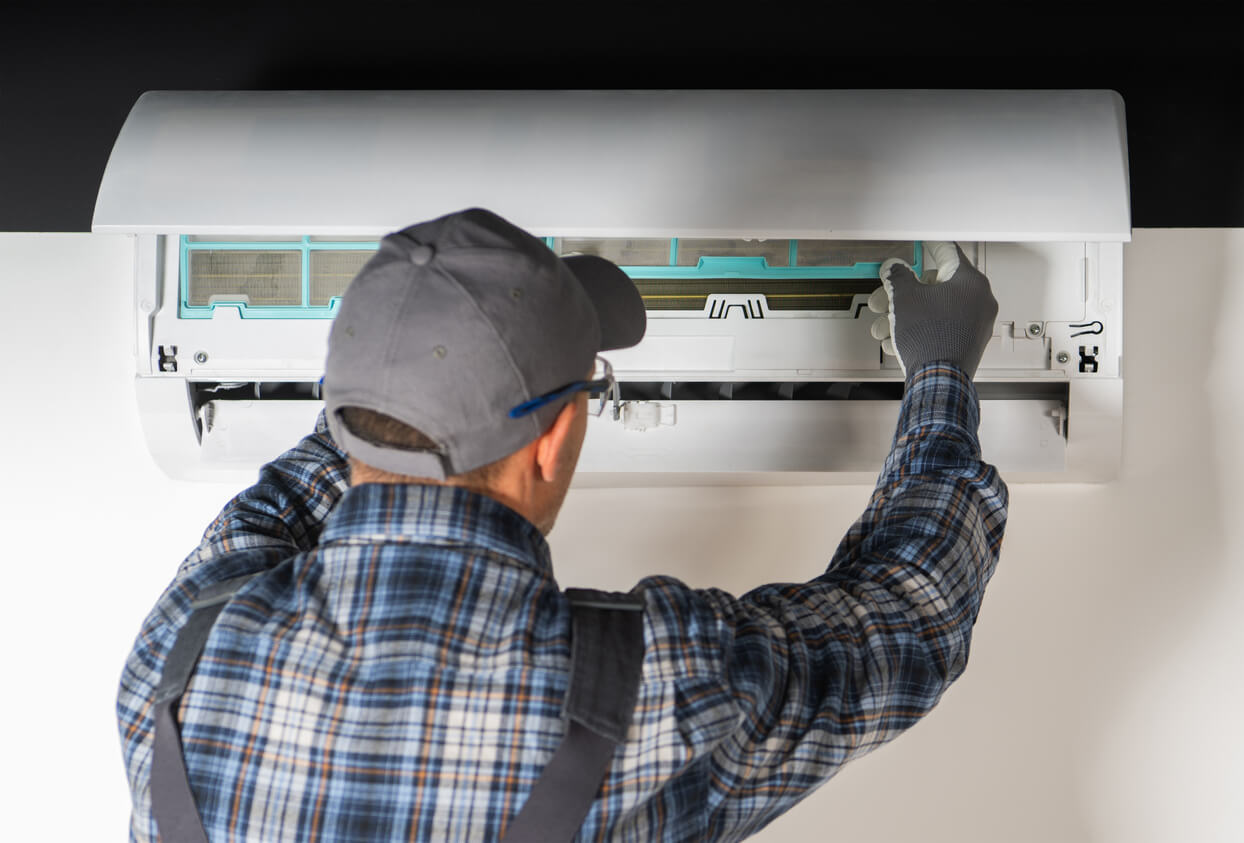
Pull out the filter and inspect it in good light. If it is packed with dust, pet hair, drywall debris, or the gray fuzz of everyday life, replace it. If you hold it up and can barely see light through it, it is overdue. Many homeowners are surprised by how much a clogged filter can affect cooling performance. It is one of the simplest fixes on the list, but also one of the most overlooked.
Make sure you install the new filter in the correct direction. There should be an airflow arrow on the frame. If the filter is backwards, it can still create problems. After replacing it, give the system a little time to recover. If the filter was severely clogged, the unit may not bounce back instantly. In some cases, a restricted filter may have already caused coil icing, and the system will need time to thaw before it can cool normally again.
If you see ice on the indoor unit, refrigerant lines, or around the coil area, turn the system off and switch the fan to on to help thaw it out. Do not chip at the ice or try to force anything. Ice is a symptom, not the root cause, and if it keeps happening, you need professional AC repair.
Look at the Breaker and Power Supply
When an air conditioner is not blowing cold air, power issues are another common possibility. Your AC system has multiple components, and sometimes one part has power while another does not. That is why you may hear the indoor fan running but still get no cooling. The outdoor condenser may have lost power even though the thermostat and blower seem to be working normally.
Go to your electrical panel and look for a tripped breaker. Air conditioners usually have a dedicated breaker, and if it has flipped, reset it once. Just once. If it trips again, stop there. A breaker that keeps tripping is not random bad luck. It is the system waving a red flag. There may be an electrical issue, a failing capacitor, a compressor problem, or another fault that needs a licensed HVAC technician.
Also check the disconnect box near the outdoor unit if you are comfortable doing so visually. Make sure nothing looks obviously damaged or out of place. If the outdoor unit is silent while the indoor fan runs, that often points to a problem outside the house, whether electrical or mechanical. If the breaker is fine and the outside unit still will not engage, it is time to move beyond DIY troubleshooting.
This is especially important during hot West Michigan stretches, when AC systems are already under heavy demand. Repeatedly resetting a breaker and hoping for the best is a little like slapping duct tape on a warning light in your car. It does not solve the problem, and it usually gets more expensive if ignored.
Check the Outdoor Unit for Obvious Problems
Your outside condenser needs room to breathe. If it is blocked by weeds, cottonwood fluff, grass clippings, or a pile of leaves left over from spring cleanup, it cannot release heat properly. That can lead to poor cooling, longer run times, and a system that seems to be working without actually making the house comfortable.
Walk outside and inspect the condenser. Clear away debris around the unit and make sure there is open space around it. If the fins look packed with dirt, that can also interfere with performance. You can gently rinse the exterior with a garden hose if the power is off, but do not use a pressure washer and do not start taking panels apart. The aluminum fins bend easily, and what starts as a helpful Saturday fix can turn into accidental damage fast.
Listen for unusual sounds too. A healthy AC unit has a steady mechanical hum. If you hear buzzing, clicking, rattling, or the fan trying to start without fully spinning, those are signs of a deeper issue. A failed capacitor, bad contactor, fan motor problem, or compressor trouble can all cause an AC unit to stop cooling. Those are repair calls, not homeowner maintenance items.
If the outdoor unit is running but the air indoors is still warm, the problem may involve refrigerant, coils, or internal components that require professional diagnosis.
Pay Attention to Signs of Frozen Coils or Refrigerant Issues
If your AC is running but not cooling the house, frozen evaporator coils may be part of the story. This often happens because of restricted airflow, but it can also be tied to low refrigerant levels. Refrigerant does not get “used up” like gas in a car. If it is low, that usually means there is a leak somewhere in the system.
Common warning signs include ice on the refrigerant lines, water around the indoor unit after thawing, weak airflow from the vents, and rooms that never quite get comfortable no matter how long the system runs. You may also notice the system short cycling or running constantly with little improvement in indoor temperature.
If you suspect frozen coils, turn off the cooling mode and let the system thaw. Running it while frozen can strain the compressor and lead to bigger damage. Once thawed, if the issue returns, call for service. Refrigerant handling is not a DIY task. It requires proper tools, correct charge levels, leak detection, and EPA-compliant handling by a trained technician.
This is where experience matters. At ACR Heating & Cooling, our technicians do not just guess and top things off. We diagnose the cause, explain what is happening, and recommend the repair that actually solves the issue.
Other Reasons Your AC May Not Be Blowing Cold Air
Sometimes the problem is not the thermostat, filter, or breaker. Sometimes your cooling system is telling you something more technical is wrong. If your central air is not blowing cold air, several components may be involved.
A failing capacitor can prevent the outdoor unit from starting correctly. A clogged condensate drain can trigger safety switches. Dirty evaporator or condenser coils can reduce heat transfer. Leaky ductwork can dump cooled air into attics, crawl spaces, or wall cavities before it ever reaches your rooms. Compressor issues can stop the refrigeration cycle entirely. In older systems, wear and tear simply catches up.
Age matters too. If your AC is 12 to 15 years old and suddenly struggling through another Michigan summer, the issue may be more than a single repair. Systems lose efficiency over time, and repeated breakdowns often show up before total failure. If the same unit has needed multiple repairs, runs constantly, or leaves your house feeling sticky and uneven, it may be worth discussing replacement options instead of continuing to patch it together.
That does not mean every warm-air problem calls for a new system. It means a professional inspection can help you understand whether you are dealing with a quick fix, a moderate repair, or a bigger decision.
When to Stop Troubleshooting and Call for Emergency AC Repair
There is a point where continuing to poke around the system stops being productive. If you have checked the thermostat, replaced the filter, inspected the breaker, and looked at the outdoor unit, and your AC still is not blowing cold air, it is time to call in a pro.
You should also call right away if you notice burning smells, repeated breaker trips, loud grinding or buzzing noises, ice buildup, water leaks around the unit, or no airflow at all. These are not “wait and see” symptoms in the middle of July. They are signs your system may be under real strain.
For families with young children, older adults, pets, or anyone sensitive to heat, cooling issues become urgent fast. Indoor temperatures can climb quickly during a West Michigan heat wave, especially in upper-story bedrooms and homes with strong afternoon sun. What starts as a comfort issue at noon can feel like a health issue by evening.
That is why a clear next step matters. If the quick checklist does not solve the problem, do not spend the whole day hoping the house cools itself. Our 24/7 emergency team is ready to get your West Michigan home cool again.
Prevent This Problem Before the Next Heat Wave
The best way to deal with an AC that stops blowing cold air is to reduce the odds of it happening in the first place. Routine maintenance gives your system a better chance of surviving the hottest part of summer without surprise breakdowns. Think of it like changing the oil in your car before a road trip instead of waiting for smoke on the shoulder.
Seasonal AC maintenance helps catch worn electrical parts, refrigerant issues, clogged drains, dirty coils, and airflow problems before they snowball. It also helps your system run more efficiently, which can lower energy use and improve comfort throughout the house. In a climate like ours, where spring can be damp and mild one week and summer can hit hard the next, that kind of preparation matters.
Changing filters regularly, keeping the outdoor unit clear, and scheduling professional maintenance before peak cooling season are simple steps that pay off. They do not just help prevent breakdowns. They help your system cool faster, run cleaner, and last longer.
Need Help With an AC That’s Not Blowing Cold Air?
If your air conditioner has stopped keeping up, ACR Heating & Cooling is here to help. We provide trusted AC repair, maintenance, and system diagnostics for homeowners in Shelbyville and surrounding West Michigan communities. Whether the fix is simple or more involved, our team is ready to find the problem and restore your comfort.
When your AC is not blowing cold air, start with the quick checklist: check the thermostat, check the filter, and check the breaker. If that does not do it, let us take it from there. Our 24/7 emergency team is ready to get your West Michigan home cool again. Contact ACR Heating & Cooling today to schedule service.